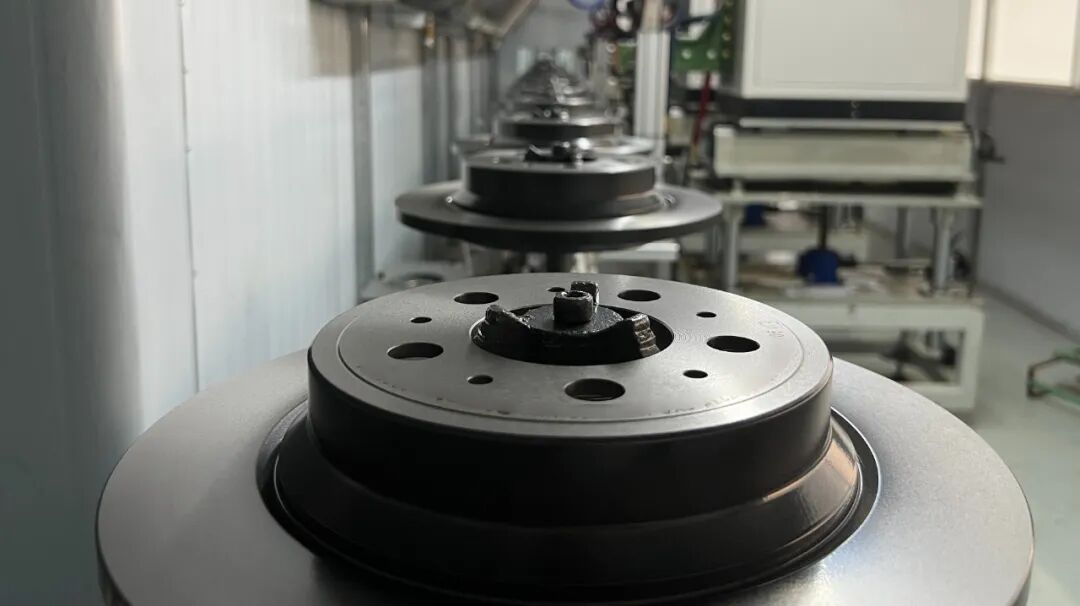
Induction Heating Spray Coating Line for Brake Discs
Against the backdrop of the automotive manufacturing industry’s continuous evolution toward higher quality and low-carbon production, brake discs—as critical safety components—are placing increasingly stringent demands on coating processes. Modern coating solutions must not only ensure corrosion resistance and consistency but also balance efficiency, energy consumption, environmental compliance, and production flexibility.
Traditional brake disc coating methods often rely heavily on manual operations and fixed production cycles, resulting in high energy consumption, intensive labor requirements, costly changeovers, and inconsistent quality. As manufacturing upgrades accelerate and environmental regulations tighten, the integration of intelligence, flexibility, and green practices has become an irreversible trend in brake disc coating line development.
01 High-Level Intelligence: Enabling “Thinking” Production
Next-generation brake disc coating lines are no longer simple assemblies of equipment but intelligent systems centered on data. Through automatic part recognition, process integration, and closed-loop data management, these lines can precisely match and stably execute coating processes for brake discs of varying models and specifications—shifting production decisions from “human judgment” to “system-driven execution.”
True intelligence lies not in the advancement of individual equipment but in the synergy and controllability of the entire line, characterized by:
- Transparent, real-time visibility of production status
- Full traceability of process parameters
- Objective, data-based quality assessment
This transformation significantly enhances coating consistency and stability while providing a reliable data foundation for lean management and continuous improvement.
02 Flexible Production: Meeting the Challenges of Multi-Variety and Rapid Changeovers
Today’s brake disc market is marked by diverse models, varying batch sizes, and frequent product switches. Coating lines must not only “perform well” but also “switch fast and adapt easily.”
The value of flexible production lies in enabling multiple disc variants to run on the same line with minimal downtime, adjustment effort, or manual intervention—enhancing order responsiveness and delivery agility. This flexibility is not merely “compatibility” but a structural capability built on system recognition, parameter management, and synchronized cycle times, transforming production complexity into orderly execution and making change a routine rather than a burden.
03 Green Manufacturing: Reconciling Efficiency and Environmental Responsibility
Under the dual-carbon goals and green manufacturing initiatives, coating processes are shifting from high energy consumption and emissions toward high efficiency, low energy use, and minimal environmental impact. Advanced brake disc coating philosophies emphasize waste reduction at the source rather than end-of-pipe treatment, featuring:
- Higher energy utilization efficiency
- Improved paint/coating material utilization rates
- Significantly reduced emissions
- Optimized footprint and operational costs
Green manufacturing is not about sacrificing efficiency; rather, it often delivers higher system efficiency and lower total cost of ownership—a result of technological advancement coupled with refined management.
04 Customization: The Highest Form of Standardization
Highly intelligent, flexible, and green brake disc coating lines deliver not only direct economic benefits—such as improved efficiency, higher yield, reduced energy consumption, and optimized labor utilization—but also broader social value: lower energy demand, reduced environmental burden, safer working conditions, and accelerated progress toward sustainable manufacturing. This reflects both corporate competitiveness and industrial responsibility.
A truly mature production line is custom-built based on the customer’s product portfolio, capacity requirements, management model, and development stage. In this process, equipment, processes, automation, and control systems are not isolated elements but cohesively designed around a unified objective—to make production smarter, more flexible, and greener.