

In Dacromet coating production, manufacturers sometimes encounter an unexpected situation: the coating solution is the same, the process settings are nearly identical, and the operating requirements have not changed, yet the finished parts show different coating results.
One batch may have a smooth and uniform surface, while another may show uneven coverage, localized coating accumulation, or variations in appearance.
Why does this happen?
The reason is that coating quality is not determined by process settings alone. In batch coating, the actual movement and behavior of the workpieces inside the equipment can have a major influence on the final result.
01 Process Settings Are Only Part of the Story
Parameters such as rotational speed, coating time, and loading quantity are important, but they only describe how the equipment is set to operate.
They do not fully describe what each workpiece actually experiences during the coating cycle.
Inside a Dacromet coating machine, large numbers of parts are continuously moving, contacting one another, separating, turning, and redistributing. During this process, the coating solution must reach different surfaces of every workpiece.
For fasteners and other components with threads, recesses, grooves, and complex geometries, this becomes especially important.
If a part remains in one position for too long, some areas may receive insufficient coating solution. If too many parts remain pressed together, other areas may experience excessive coating accumulation.
As a result, identical machine settings do not always mean identical coating conditions.
02 Workpiece Movement Directly Affects Coating Uniformity
The purpose of a batch coating machine is not simply to rotate a basket of parts.
A more important function is to create a controlled and continuous movement pattern that allows the workpieces to repeatedly change position and orientation.
This movement helps expose different surfaces to the coating solution and reduces the possibility of prolonged contact or stacking between parts.
If the movement inside the basket is too limited, certain surfaces may remain shielded. If the parts gather in one area for too long, coating distribution may become inconsistent.
Therefore, the movement generated by the equipment is not separate from the coating process—it is part of the coating process.
The more effectively the equipment controls workpiece movement, the easier it becomes to achieve repeatable and uniform coating results.
03 Why Rotational Speed Alone Is Not Enough
Rotational speed is often used as a key reference when evaluating coating equipment. However, the same speed can produce very different workpiece behavior depending on the machine design.
A simple rotational movement mainly changes the circumferential position of the parts.
By comparison, a compound movement can continuously change the orientation of the workpieces in several directions, helping them roll, turn, and redistribute more frequently.
This is particularly useful when coating fasteners in large batches.
For this reason, faster rotation does not automatically mean better coating quality.
The more important consideration is whether the machine’s movement pattern is suitable for the workpiece geometry, batch size, and coating process.
In a planetary coating system, the coating basket rotates around its own axis while also revolving around the central axis of the machine.
This combined motion creates more complex and continuous movement inside the basket. The workpieces are able to change orientation more frequently rather than remaining in a relatively fixed position.
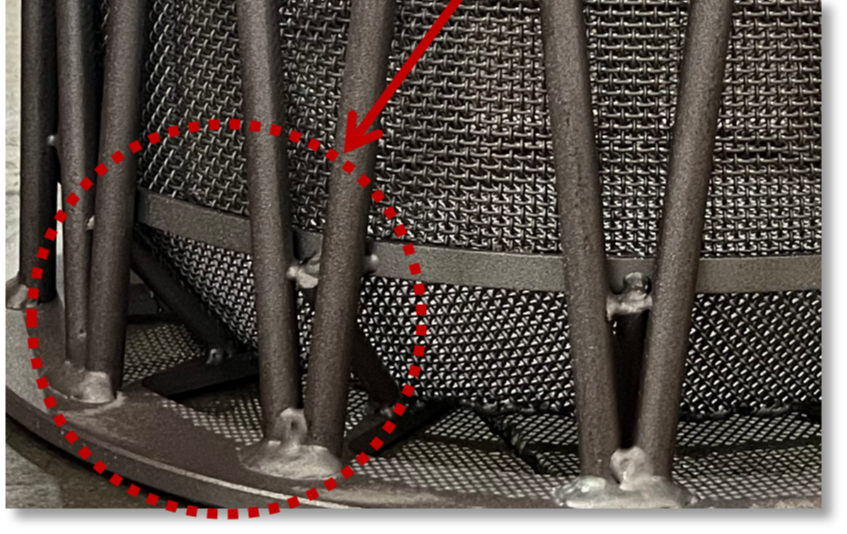
An angled basket-bottom structure can further encourage parts to roll and turn during operation, helping create more consistent contact between the workpiece surfaces and the coating solution.
04 Stable Equipment Operation Helps Turn Parameters into Results
Dacromet coating quality is influenced by many factors, including:
- coating solution properties;
- workpiece shape and surface condition;
- loading quantity;
- equipment movement;
- operating parameters;
- and curing conditions.
These factors must work together.
The role of the coating equipment is to consistently reproduce the required operating conditions from one batch to another.
If the machine maintains a stable movement pattern and allows the parts to move in a controlled and repeatable way, the process parameters are more likely to translate into consistent coating performance.
This is why equipment evaluation should go beyond specifications such as maximum speed, basket capacity, or available functions.
The key question is whether the machine design can convert those specifications into the actual workpiece movement required by the coating process.
05 Better Process Control Starts with Better Matching
For an established Dacromet or zinc flake coating process, reliable results depend on more than adjusting individual parameters.
The coating solution, workpiece characteristics, loading method, equipment motion, and curing process all need to be properly matched.
When the equipment provides more stable and appropriate workpiece movement, unnecessary process variation can be reduced and batch-to-batch consistency can be improved.
So when the same coating process produces different results, the solution may not simply be to increase the speed, extend the coating time, or change one setting.
It is often necessary to examine the entire coating process and, in particular, how the workpieces actually move inside the equipment.
For Dacromet coating equipment, effective design means more than achieving a specific parameter on paper. It means understanding the coating process and the workpieces, then using the machine structure and motion system to produce more stable, controllable, and repeatable coating results.
Post time: Sep-14-2026